The process of scaling a small business can be challenging because the communication lines that used to support it previously can falter with its growth. A strong software framework is required to keep pace with growing customer demands. An Agile software approach gives scaling companies operational flexibility. It allows cross-functional teams to deliver quick results by breaking complex initiatives into shorter development cycles.
What Is Agile CRM Software?
Agile CRM is a cloud-based software that combines customer data tracking with flexible project management tools in a dashboard. This approach allows the sales, marketing, and support teams to evaluate and take action according to customer behaviours. The software visualizes the work to track its progression, which helps teams optimize their operations. This eventually benefits small and mid-sized businesses to grow in an organized manner.
Improve Workflows Through Integration
Various Agile CRM integrations enable data to flow smoothly across apps, increasing efficiency. You can activate built-in integrations for mainstream tools directly through the admin settings panel without writing any code. Businesses usually go for the following integrations:
| Category | Integration | Benefit |
| Emails | Google Workspace, Outlook | Syncs customer email history directly to the CRM timeline. Also attaches Docs to contacts. |
| E-Commerce | Shopify | It tracks shopping behavior to automatically trigger discount text messages and emails |
| Billing and finance | QuickBooks Online, Stripe | Views active customer subscriptions and process statuses within the dashboard. It also syncs sales invoice and payment histories into customer profiles. |
| Calling | Twilio | This enables automated power-dialers and one-click calls. |
| Customer help desk | Zendesk Support | It shares open support tickets with sales reps before they jump on discovery calls. |
| Social media | Facebook, LinkedIn, X | It gathers lead histories and pulls contact images directly from socials |
Agile Software Development Methodology For Small Businesses
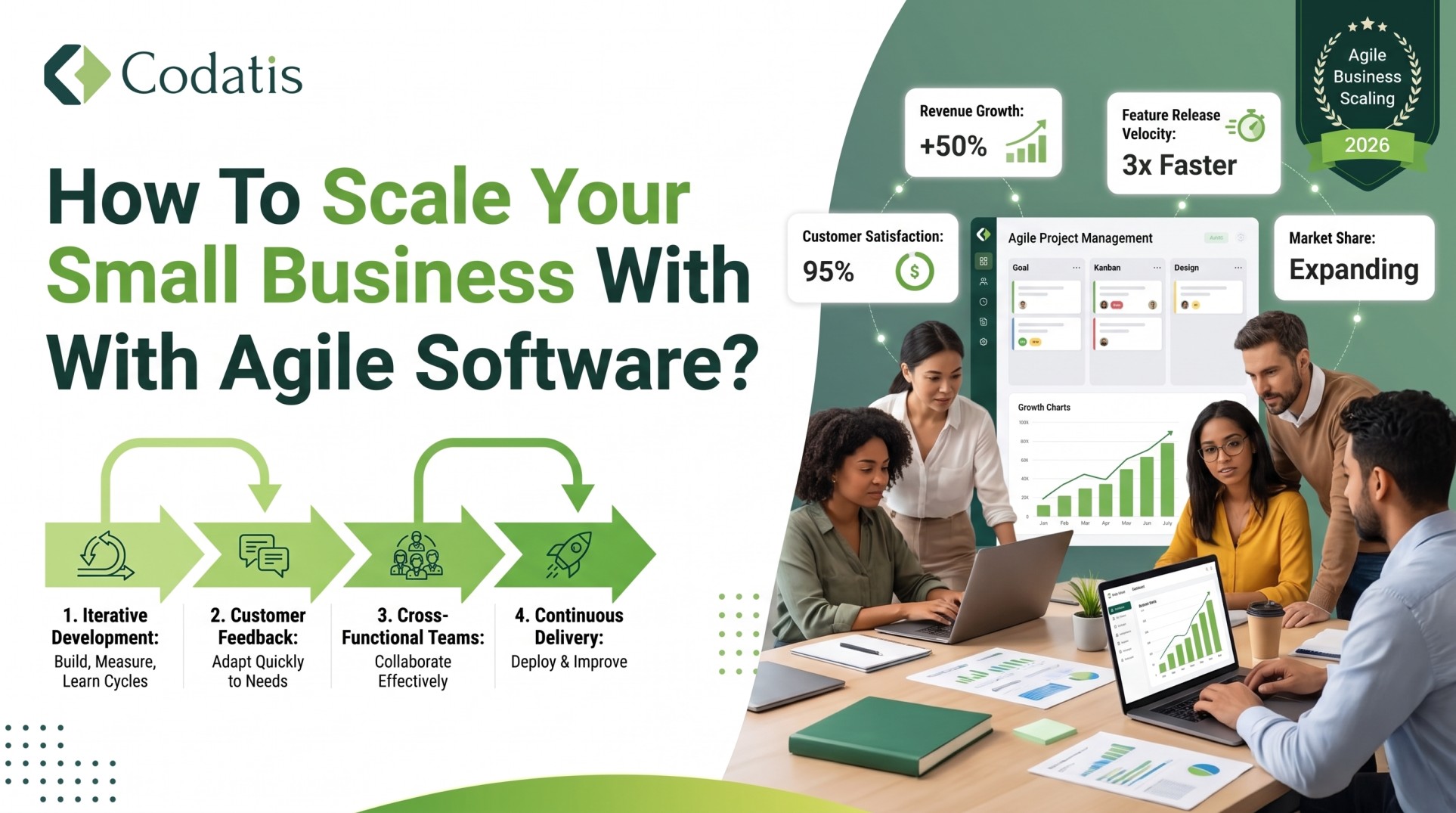
This software allows emerging companies to replace long planning with a rigid roadmap with shorter and repeatable cycles. This means that small businesses are able to utilize software features in less time rather than waiting for final launch. The process of agile software development is listed as:
- Define project goals while keeping in view the requirements of users and budget limits.
- Develop the software features in manageable pieces.
- Run immediate quality checks to catch bugs early.
- After testing, gather the user feedback and plan the next cycle accordingly.
Agile Software Development Sprint
A sprint is a fixed time during which a team focuses on delivering a specific set of features. This time period is usually 1 to 4 weeks, where a team elects priority items from the backlog to complete during the sprint. During this time, the functionality of the agile software development terms is tested and reviewed. which is how a custom software development company keeps each iteration on track. This feedback helps with better planning for the next cycle.
Benefits Of An Agile Software Management Tool
Project management Agile software provides a platform for small teams to track and execute daily operations without any kind of hassle. It provides a single system where there is no need to worry about finding any kind of data available in multiple spreadsheets. The advantages of this solution include:
Enhance Project Visibility
The main Agile software development concepts include splitting massive projects into small pieces to reduce risk. This helps owners and team members see which tasks are completed and how close a project is to completion. This ensures transparency and allows everyone to be accountable for the tasks they perform.
Higher Flexibility
Agile software allows small business to design their strategies according to fluctuating market conditions. They can easily change priorities for a project when work is broken down into shorter tasks. If a client requests a sudden change, it is possible to adjust the focus of the next sprint. This ensures your team is always working on the highest-value tasks.
Early Bug Detection
The tools in this software encourage continuous testing throughout the creation process, so that any kind of error or gap can be identified early. The mistake can be fixed easily before any substantial loss.
Easy Collaboration
The communication between teams can be made smooth, as this software allows team members to leave feedback on specific task cards and share files in real time. The marketing, sales, and development teams can align through Agile software project management to achieve the same goals.
Faster Release
Businesses do not need to wait for many years or months for teams because the solution releases a Minimum Viable Product at the end of every sprint. This rapid release cycle allows your small business to start generating revenue quicker and outpace competitors.
Agile CRM Pricing for Small Budgets
The cost of the platform depends on the tier that the business chooses according to its scale. Its pricing is calculated per user, per month. When more team members are added, it multiplies the baseline monthly cost. The cost plans for Agile include:
| Plan | Price (Per User/Month) | Contact Database Limit | Best For |
| Free | $0 | Up to 1,000 | Up to 10 users for testing the platform. |
| Starter | $8.99 | Up to 10,000 | Small teams that need 2-way email sync and basic automation. |
| Regular | $29.99 | Up to 50,000 | Growing teams that require telephony support. |
| Enterprise | $47.99 | Unlimited | High-volume sales teams for call recording and complex analytics. |
How To Implement Agile Softwares
It is important for the team to learn about the software to ensure all operations are carried out without any hurdles. First of all, it is important to audit operations to identify blockages. Train the teams in Agile software methodology that is focused on collaboration, frequent updates, and flexibility over rigid plans. The teams can be made aware of their roles, and their progress can be updated through this platform to find out the completion status of a task.
Conclusion
Small businesses can make their operations smooth by choosing the best Agile software that gives them a flexible structure that lets them scale even with a limited budget. The flexibility of the platform allows the business to develop strategies that meet the requirements according to the ever-changing requirements of the market and customers. The solution allows the team to check for quality during every short work cycle to help catch risks at an early stage. This constant checking ensures that every update works perfectly and gives your customers exactly what they want.